
Overview
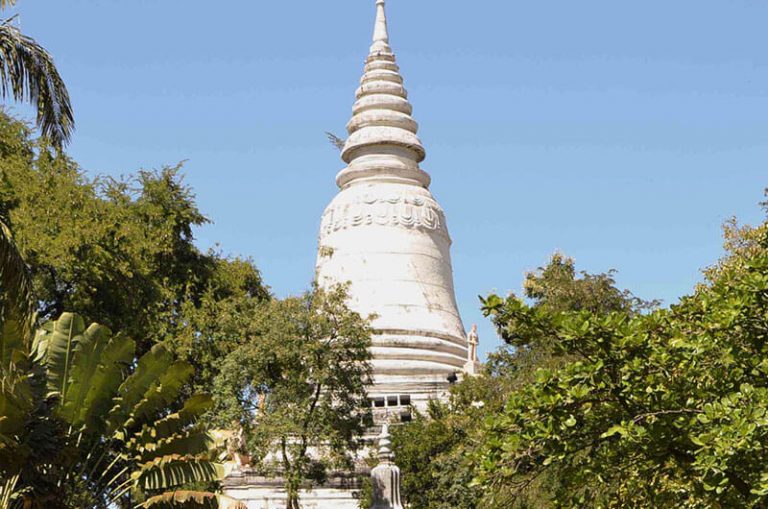
Wat Phnom, literally translated as “Mountain Pagoda,” is a Buddhist temple built in 1372. It stands at 46 meters, or 150 feet – an impressive height for the only hill in Phnom Penh. The pagoda was named after Daun Penh, or Lady Penh (“Grandmother” Penh), a wealthy widow, credited for her discovery and founding of Phnom Penh in 1372. Since then, the pagoda has undergone reconstruction several times, including in 1434, 1806, and 1890-1894. The modern-day structure of the pagoda dates back to 1926.
Legend Behind Wat Phnom
According to legend, Lady Penh discovered four Buddha statues on the Tonle Sap River. Lady Penh took this as a sign and built a pagoda atop a hill to house the statues. Eventually, the area became known as a pilgrimage site and grew into a small settlement. After the invasion of the then-capital city of Angkor, Wat Phnom marked the center of the kingdom’s new capital city known today as Phnom Penh. In its literal translation, Phnom Penh means Penh’s Mountain or Hill, paying homage to Lady Penh as the capital’s founder.
Tips on Visiting Wat Phnom
Wat Phnom is relatively easy to visit. If you’re staying at the Ohana Phnom Penh Palace Hotel, Wat Phnom is located only 1.2 kilometers (0.75 miles) away! It is located only a block away from the Tonle Sap River and within walking distance of the Central Market (Phsar Thmey). To enter the pagoda on the hill, visitors must pay a $1 USD (4,000 riels) entrance fee at the ticket office at the bottom of the east-side staircase.
There are many interesting things to see around Wat Phnom, including the ashes of King Ponhea Yat housed in a stupa behind the pagoda, paintings of Buddha’s story before enlightenment, and the sanctuary’s gardens.
When visiting Wat Phnom, note that visitors should dress modestly and respectfully. Visitors are also asked to take off their shoes when entering the primary worship area. Though heavy traffic may circle the pagoda, the sanctuary’s grounds feel secluded enough for visitors to enjoy the historical site. Visitors should be mindful that the temple remains an active religious site where locals may also go to pray. As such, it may become busier during religious events and holidays, especially Cambodian New Year.